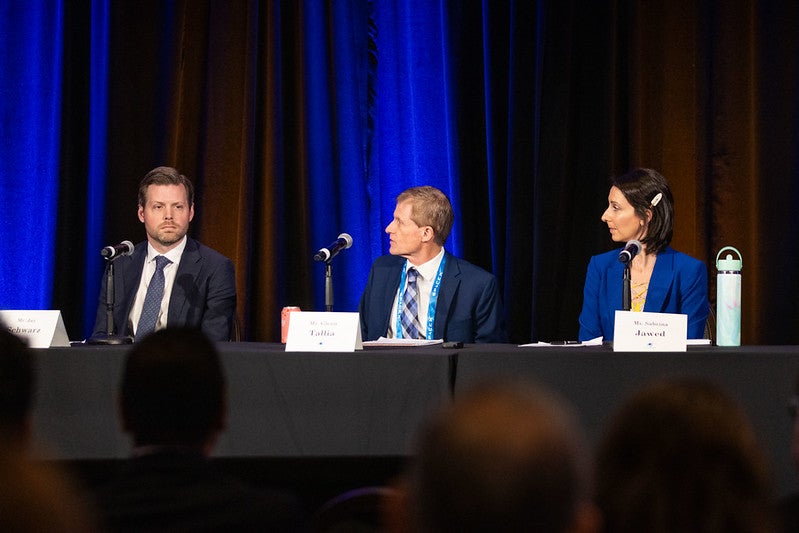
COLORADO SPRINGS, Colo. — With the pace of development in the commercial space industry over the last decade, regulators continue to work through how to oversee that development while enabling innovation. That was the topic of discussion featuring three experts from government regulatory agencies representing the FCC, the National Oceanic and Atmospheric Administration (NOAA), and the Federal Aviation Administration (FAA) to kick off Space Symposium in Colorado Springs.
We are experiencing a space industrial revolution, according to Jay Schwarz, Space Bureau chief of the FCC, adding that the space industry has gone from a small number of systems that tend to take a very long time to build and deploy, to a rapid cadence of launch, deployment, and innovation.
“If I had to then connect this to what we’re doing at the FCC, it really boils down to the fact that we need to make sure that government is scaling to match what’s happening in the industry. Both the volume and the complexity of what we have been faced with at the FCC in terms of licensing these systems have changed,” Schwarz said.
In his time as Space Bureau chief, Schwarz has made modernizing satellite licensing a top priority.
Running down a history of rulemaking was the Chief Legal Counsel for NOAA, Glenn Tallia, helping to put things in context and demonstrate the progress that has been made over the last seven years.
“In 2018, we were directed to either rescind our regulations or revise them,” he said. “So we undertook a major review of our regulations because they weren’t effective now, given the big increase of activity in the private remote sensing area. We issued a final rule in July 2020, and we’ve been implementing that rule since then. That rule was a paradigm shift in how we regulate,” Tallia said.
In 2020, NOAA’s Commercial Remote Sensing Regulatory Affairs (CRSRA) office changed the way it regulated licensing for remote sensing systems, mandating that government could only restrict unique capabilities for up to three years to allow for time to develop mitigations.
Sabrina Jawed, the deputy assistant chief counsel, regulations division of the FAA, pointed to a change at the FAA creating performance-based requirements, that would allow operators to iterate without having to request a waiver from the FAA.
As a result, the FAA formed a launch and re-entry licensing rulemaking advisory committee of stakeholders and industry participants to examine the regulations and look to streamline the regulations while maintaining the FAA mandate, she said.
The goal was to “allow for the development and the innovation and the cadence that industry needs,” Jawed said. “Because, of course, industry moves at the pace of industry. Government moves at the pace of government. And those two things don’t always work well together.”
“Ideally, we want to create a regulatory structure that allows for government to work closely with industry and be a partner to industry, as opposed to holding them back,” she added.